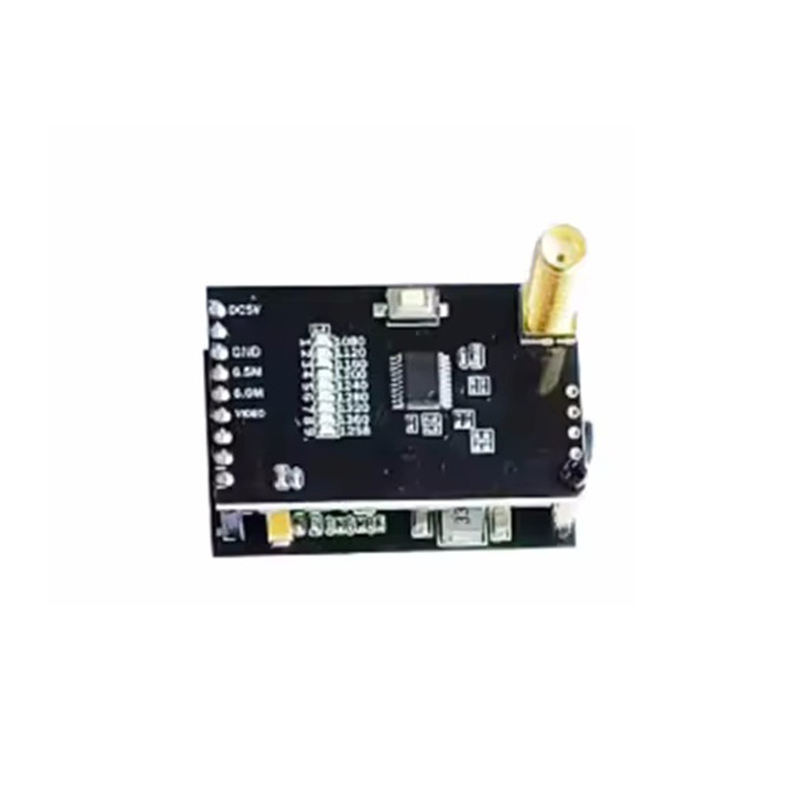
1.2GHz 1080-1258MHz 9CH 95dBm High Sensitivity Wireless Video Receiver Module
Product Description:
Here is a detailed description of the advantages of a 1.2GHz frequency, 9CH VRx (Video Receiver) for drones.
Advantages of a 1.2GHz, 9CH VRx (Video Receiver)
A 1.2GHz, 9-channel VRx is a specialized ground-based receiver designed to complement and maximize the performance of 1.2GHz video transmitters (VTxs) used in long-range (LR) and Beyond-Visual-Line-Of-Sight (BVLOS) FPV drone operations. Its advantages are centered on superior signal reception, interference mitigation, and operational flexibility at the lower frequency band favored for extreme range.
1. Core Frequency Advantage (1.2GHz Band)
Optimal Long-Range Reception:Paired with a 1.2GHz VTx, this receiver exploits the fundamental propagation benefits of the lower frequency. Signals in the 1.2GHz band experience less free-space path loss and have better diffraction properties compared to the common 5.8GHz band. This allows the VRx to capture a usable video signal from greater distances and in environments where the signal path is partially obstructed by light foliage or terrain.
Reduced Atmospheric and Environmental Attenuation:The 1.2GHz signal is less susceptible to attenuation from atmospheric moisture and other particles, making it more reliable for long-distance reception, especially in humid or suboptimal weather conditions where higher frequencies might degrade more quickly.
2. Enhanced Channel Selection (9CH)
Superior Interference Avoidance and Management:The availability of 9 discrete channels within the 1.2GHz band is a primary operational advantage.
Finding the Cleanest Frequency:It allows the pilot to manually or automatically scan and select the channel with the least amount of background noise and interference from other 1.2GHz sources (e.g., other long-range pilots, legacy wireless systems, or harmonic interference). This results in a clearer, more stable video feed.
Coordination in Multi-Pilot/System Environments:Essential for professional or team operations. Multiple ground stations or receivers can be tuned to different, non-overlapping channels to monitor multiple drones simultaneously without cross-channel interference. This is crucial for collaborative missions, chase planes, or redundancy setups.
Fine-Tuning for Peak Performance:The granular channel selection enables precise matching to the exact output frequency of the VTx. This ensures the receiver is tuned to the center of the transmitter's channel, maximizing signal strength and minimizing artifacts, especially when using narrow-bandwidth or high-efficiency receiving modes.
3. System Performance and Compatibility Advantages
High Sensitivity and Selectivity:A quality 1.2GHz VRX is designed with components optimized for high sensitivity (the ability to receive weak signals) and good selectivity (the ability to reject adjacent channel interference). This is critical for pulling in a clean signal from the edge of its range.
Compatibility with High-Gain Antenna Systems:The 1.2GHz band is particularly well-suited for use with directional, high-gain receiving antennas like patch antennas, helical antennas, and parabolic dishes. The VRx's 9-channel agility allows the pilot to fully leverage these antennas by ensuring they are tuned to the optimal frequency, dramatically increasing effective range and signal-to-noise ratio when the antenna is pointed correctly.
Support for Advanced Features:Many 1.2GHz VRx units support advanced features like:
Diversity Reception:The ability to connect two or more antennas (e.g., one directional and one omni-directional) and automatically switch to the antenna with the strongest signal, providing a more robust link.
Digital Signal Processing (DSP):Internal filtering and processing to clean up the video signal, reduce static ("snow"), and improve clarity.
Low Noise Amplifier (LNA) Integration:Many systems allow for an external LNA to be placed close to the antenna to boost the weak incoming signal before any cable loss occurs, which is a key technique for maximizing range.
Synthesis of Advantages
The 1.2GHz, 9CH VRx provides a flexible, sensitive, and intelligent reception platform specifically optimized for long-range FPV. Its advantages are not in raw power (like a VTx) but in its ability to efficiently capture, select, and process the weak signals coming from a distant drone.
1.2GHz Frequency:Enables reception of signals that travel farther and penetrate better.
9 Channels:Provides the tools to find the clearest signal path and coordinate multi-system use.
High-Quality Design:Ensures weak signals are amplified and processed with minimal degradation.
Key Consideration for Optimal Use:
Antenna System is Paramount:The performance of any VRx, especially at 1.2GHz, is heavily dependent on the antenna system.To realize the full benefit of its 9-channel tuning and sensitivity, it must be paired with high-quality, properly tuned antennas. For maximum range, a high-gain directional antenna (like a helical or patch) mounted on a tracking system is ideal.
Summary:
The 1.2GHz, 9CH VRx is a critical component in a long-range FPV system,acting as the sensitive "ear" on the ground. Its advantages are enhanced signal reception for extreme distances, superior interference management through multiple channels, and the flexibility needed for professional multi-drone operations.It is an essential tool for pilots and professionals who rely on maintaining a clear, stable video link from their aircraft at the limits of visual and radio line of sight.


 Your message must be between 20-3,000 characters!